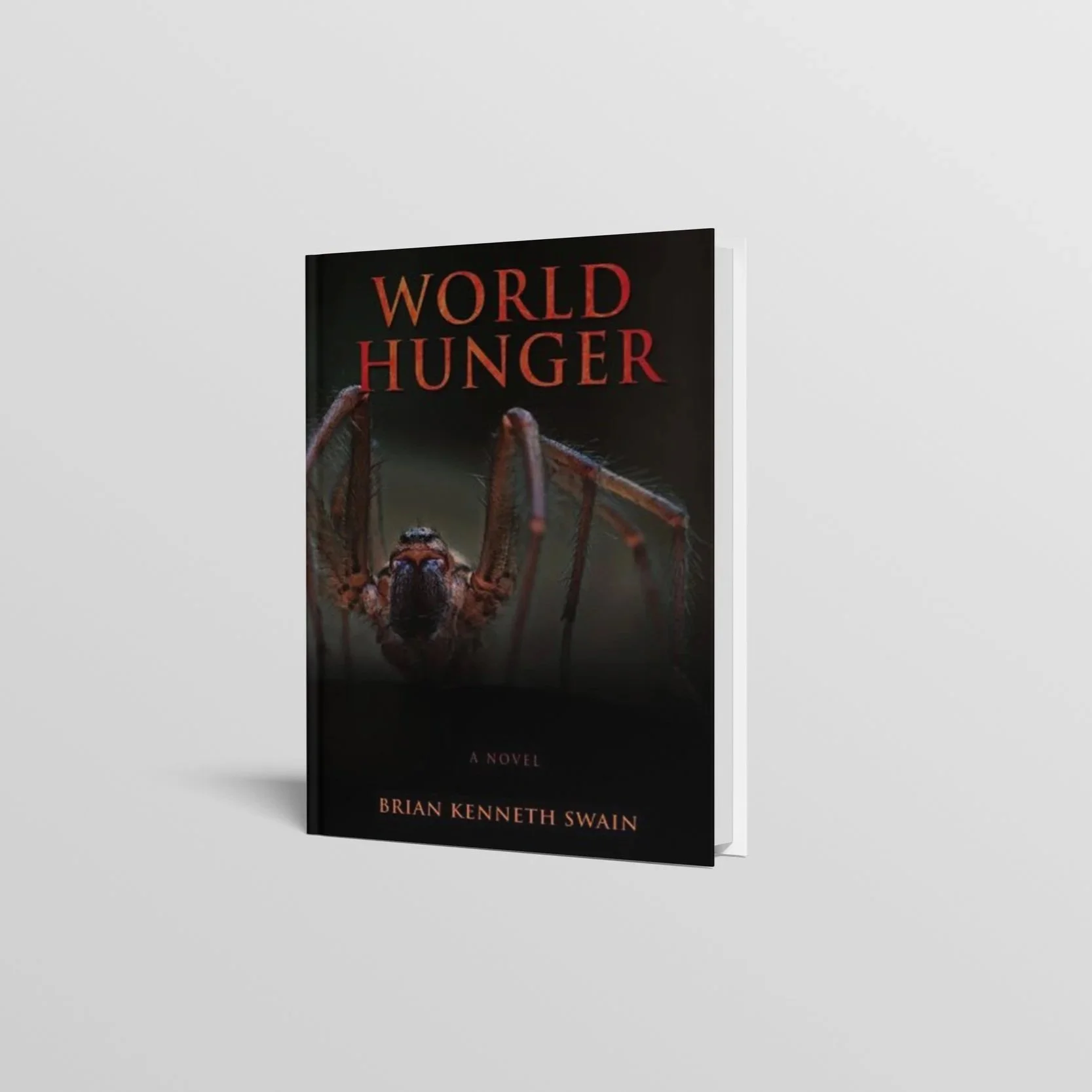
World Hunger
THEY SAY “YOU ARE WHAT YOU EAT”…
Using facts straight from today’s headlines, Brian Kenneth Swain, author of World Hunger, takes a fictional but frightening “what-if” look at the genetically modified foods currently being grown and consumed around the world.
Looking through the eyes of the three major players: the corporate giants that control the purse strings, the scientists who are trying to play by the rules of ethics, and the environmentalists who vehemently oppose this exploitation of nature, Swain tells a gripping story of exploitation versus assistance.
He says, “The concept behind World Hunger centers on the most controversial option for feeding the world’s hungry. Do those facing starvation embrace genetically modified foods and take a chance on unknown long-term risks? Or do they play it safe, avoid genetically modified foods and risk starvation? I’m convinced many would rather eat now and worry about ‘later’… later.”
But, he adds, that still doesn’t negate the responsibility of large corporations who, in their pursuit of profit, rush in to market with hastily developed products. Swain will engage your imagination while challenging your thinking about:
Whether big business should be allowed to “own” plant species created by nature such as corn and rice that have been planted by farmers for centuries.
The ethical trade-off between companies making a profit by feeding people who have nothing
Weighing the ethics of actions against the need for a livelihood
World Hunger is a fast-paced thought-provoking exploration of the biotech industry and its impacts on the foods we eat every day.
Media Coverage
Click here to read the Q&A with the author from The Times Record.
Press Releases
What if you had the ability to feed the world’s hungry?
But then something went terribly wrong…
Brian Kenneth Swain, author of World Hunger (iUniverse, Inc., August 2007), takes you from the front page of today’s news into the corporate hallways of Vanguard Corporation, a fictitious agricultural company led by a greedy CEO with money to burn and backers to answer to.
“Although it is possible to make money and do good things, almost everyone, at some point, finds themselves in a position of having to weigh the ethics of their actions against the need for a livelihood…. but at what cost? This is the focal point in World Hunger, explains Swain.
In World Hunger, readers are drawn into real life ethical dilemmas as they follow Vanguard’s development of a new line of genetically modified seed products that are guaranteed to greatly increase crop yields and resist draught, pests, and disease all in the name of reducing hunger in Third World countries. And, of course, it doesn’t hurt that these crops will also earn huge profits for the firm. If it sounds too good to be true…
Vangaurd’s initial testing in Columbia and India look successful at first glance, but halfway through the crops development, reports begin to emerge of bizarre insect sightings that are linked to incidents of domestic animal slaughter, and eventually, the death of several people. The high-growth genetic enhancements engineered into the seeds have been transferred to the insects through their ingestion of the test crops, creating the first generation of “super insects”.
The strains of these mutations are much larger, more aggressive, and increasingly resistant to pesticides and disease than their natural counterparts. As the insect populations begin to grow, Vanguard desperately combats them while juggling the media, environmentalists, and the government.
Meanwhile, scientists, entomologists, and field operatives frantically work together to kill off these new species they’ve created and deal with the fallout of mankind’s apathy toward environmental meddling.
World Hunger examines real-life issues of speed versus safety in bringing new products to market and the ethical trade-off between big business persuing profits while feeding hungry people.
World Hunger is a page-turner that will leave you starving for more.
Excerpt from World Hunger
Thursday, June 20th – 10:45 p.m.
By the time Hemant Patel had discovered the cutter ant damage in his cornfield four weeks earlier, the colony had already been in residence for more than six months. In fact, the colony’s founder had been originally attracted to the field by the turning of soil in preparation for planting of the test crop. The loose rich earth was prime real estate for a new ant colony, particularly given its close proximity to the wealth of consumable foliage surrounding the outer boundaries of the field. Having two hectares of new, genetically enhanced corn arrive a few month later was an unexpected fringe benefit.
The queen had flown into the Vanguard field sometime the previous November, looking for a desirable spot to start a new family. Following fertilization at the old colony, she had arrived here after an exhausting flight of more than seven kilometers. Having selected a promising location near the south end of the open field, she had shed her now-useless wings, dug a two-inch deep hole in the loose black soil, and deposited a small number of eggs. By regurgitating a bit of fungus brought along for the occasion, she then started a small garden with which to feed her incipient offspring. Before long the queen was accompanied by a small host of newly hatched workers, who promptly made their way to the surface and set out in search of fresh new foliage to replenish the fungus garden – the colony’s sole future food source.
During its first five months of existence the young colony grew steadily to include over five hundred thousand residents. By this time, the network of caverns had expanded to more than eight feet below the surface, and the ants had excavated more than three hundred pounds of soil, all of it deposited on the surface. Then late spring had come and, with it, the planting of the new Vanguard corn crop. As the shoots rose and expanded, they provided an abundant, and much closer, food supply for the colony, which continued to grow rapidly. In the weeks that followed, the tender new corn shoots quickly became the major constituent of the colony’s food supply, and several generations of ants that lived on this diet began to evolve in some new and striking ways.