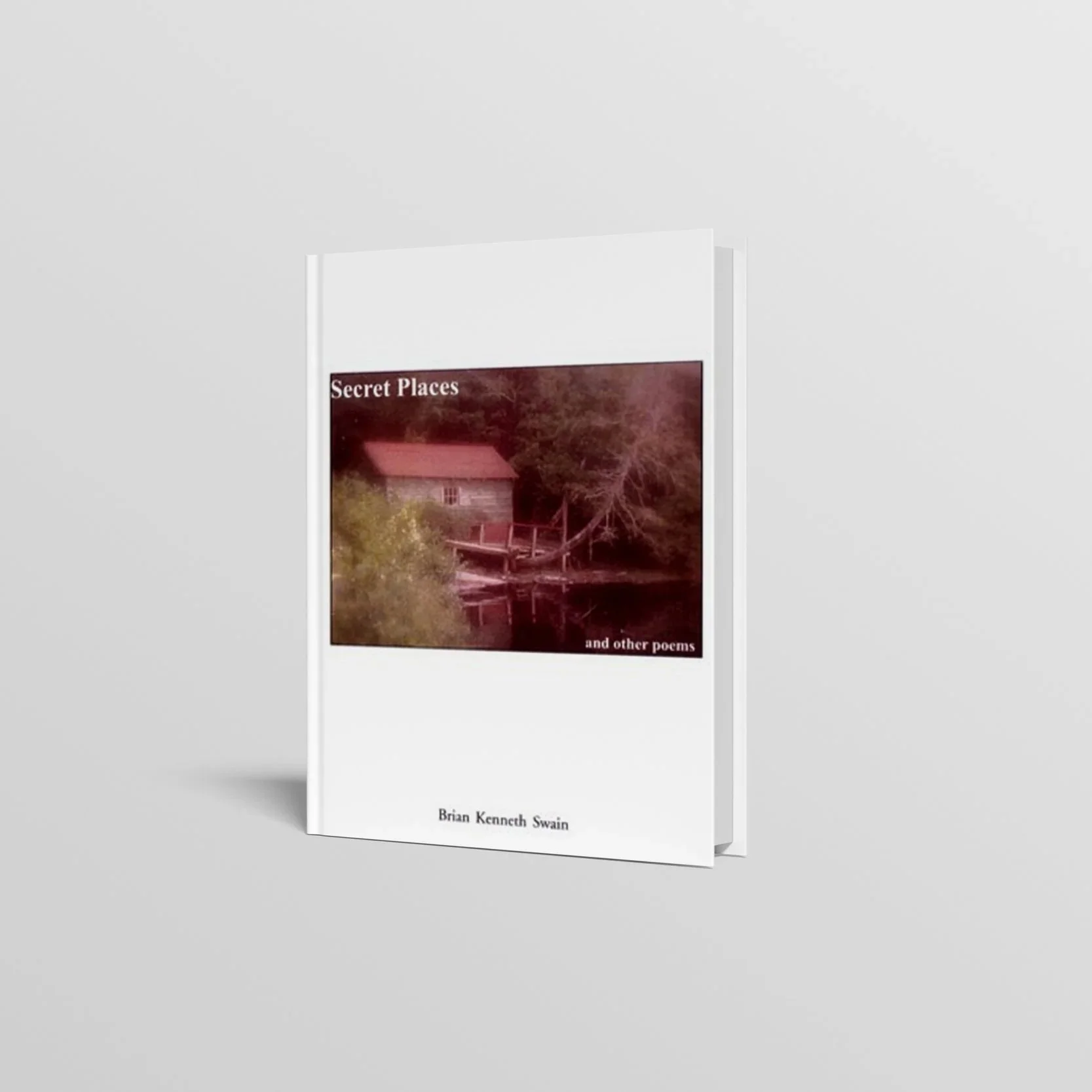
Secret Places
Secret Places by Brian Kenneth Swain is worth a look. This is a competent, well-balanced collection of free verse narrative poems that engage the reader in the author’s reflections on love, war, friendship, family, death and even Leonardo Da Vinci.
“To An Old Friend Across the Ocean” is a fine example of the “epistolary” (letter) poem, written in this case to a dead friend. The poet discloses that he has written several letters to his friend in the past that have gone unanswered, until one day he finds an envelope from your address/ but with my name/ written in an unfamiliar hand. He discovers that the letter is from The one who lived with you./ The one who knew no English./ The one who tolerated/ my bad German. The poem is written in plain but powerful words (as one might actually write such a letter) and, as psychotherapists will tell us, it is a healthy thing to write a letter to a dead friend, particularly if there was no opportunity to say good-bye.
The challenge in writing about one’s own problems is that it takes skill and good judgment to make the reader care about the author’s sorrow. The trick is to give the poem some punch but avoid being sappy and sentimental. Swain does it well with another epistolary poem, “My Friend Phillip,” which broaches the theme of suicide. How bad/ could things have been,/ that a family’s love/ could not assuage?// …I was two hundred sixty one miles/ away.// …I would have come./ You only had to call.// I would have come.
One of my favorites in this collection is “Leonardo’s Lunchbox,” in which the author wryly speculates on the kind of midday meal the great philosopher, artist and inventor might have favored: I’m betting he was a/ bologna and cheese sort of fellow,/ no squishy formless egg salad/ for the master geometrician./ He would be drawn inexorably/ to the precisely circular/ slice of uniform pink meat.// …[and] a hard boiled egg,/ whose shape would have pleased him,/ and whose yolk-ensconcing allegorical qualities/ would have satisfied/ his most philosophical yearnings.
Similarly appealing is the delightful “Gravity,” in which the poet declares, I remain stuck on this ball/ like a gnat on flypaper./ …I sit,/ a prisoner of physics,/ bound tight as a stamp on a letter,/ centrifugal force be damned.Swain goes on to say that gravity . . .unerringly/ draws the buttered side of my toast/ to the linoleum. It is not simply that the poems about Leonardo and gravity are humorous, but these poems are original and contain some of Swain’s best imagery.
Credit: MSR Reviews – Richard Allen Taylor – Fall 2005
Poems from Secret Places
Leonardo’s Lunchbox
Inventor,
Painter,
Poet,
Philosopher.
The defining renaissance man.
I’m betting he was a
bologna and cheese sort of fellow.
No squishy formless egg salad
for the master geometrician.
He would be drawn inexorably
to the precisely circular
slice of uniform pink meat.
Add to this
one compellingly orthogonal
slice of yellow American,
its corners only just touching
the bologna’s circumference
(like the naked man in that famous sketch)
Then punctuate
this blessed symmetry
with a delicate abstract swirl
of bright yellow mustard-
perhaps the inspiration for
the Mona Lisa’s
gracefully curved finger.
To then hide such perfection
between slices of Wonder Bread
would doubtless have
disturbed the old master.
And to accompany the sandwich?
I’m guessing a hard-boiled egg,
whose shape would have pleased him,
And whose yolk-ensconcing
allegorical qualities
would have satisfied
his most philosophical yearnings.
To top off the perfect lunch-
surely a Devil Dog or Ring Ding,
either, an exercise in spatial symmetry
no box of raisins could ever
hope to achieve.
Aroostook
You’re bound to get idears
if you go thinkin’ about stuff.
John Steinbeck
The Grapes of Wrath
Hands and knees.
Cold early fall morning.
Winter not quite
at the front door yet,
But coming up the walk
bearing a look of frigid resolve.
Baby fingers that should be
clutching pencils,
reciting numbers and letters,
grapple instead beneath the
thick black Maine soil
in search of hard brown potatoes.
It’s two weeks every autumn,
from eight years old to eighteen,
longer if you
can’t find a way out.
And so they spend the days
with their hands filling the boxes,
and their heads dreaming of escape
as late afternoon sun
throws long shadows
over the field,
stark reminder of
how far away from here
everything else is.
But the minds of the
children turn,
like the black soil turns.
And like the potatoes
that spring from underground,
the occasional fortunate child
thinks of a way
and departs silently
without daring to look back.
2004 Pushcart Prize Nominee — Edgar Literary Magazine